Abacus.AI Review: Is This the All-in-One AI Operating System Your Business Needs?
In today’s fast-evolving tech landscape, professionals and enterprises often find themselves managing a fragmented collection of AI tools, each with its own subscription, interface, and limitations. This complexity can hinder productivity and drive up costs. Enter Abacus.AI, a platform aiming to consolidate these disparate AI capabilities into a single, unified ecosystem, positioning itself as an “AI Super Assistant.”
This comprehensive Abacus.AI review will explore whether this ambitious platform truly delivers on its promise. We’ll examine its core features, pricing, real-world applications, and how it stacks up against alternatives. By the end, you’ll have a clear understanding of its strengths, weaknesses, and whether it’s the right fit to enhance your team’s productivity and AI strategy.
What is Abacus.AI?
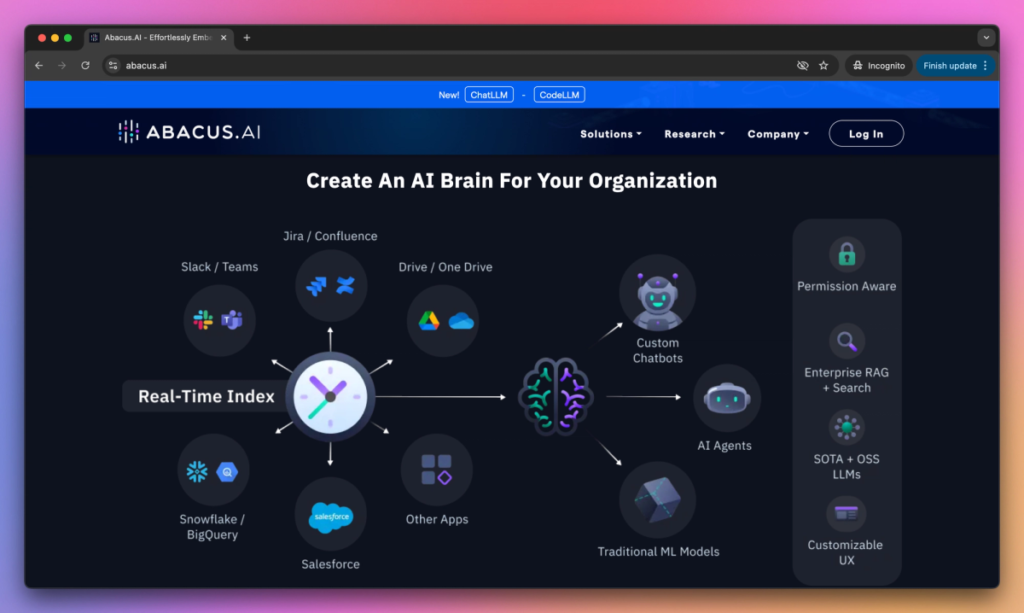
Abacus.AI is a generative AI company offering an integrated platform for professionals and enterprises to leverage artificial intelligence across a wide array of tasks. It functions as an “AI operating system,” providing a single interface to access and utilize various top AI models—including GPT-4o, Claude 3.5 Sonnet, Gemini 1.5 Pro, Llama 3.1, and its own Flux models. Beyond model access, Abacus.AI provides specialized tools for building full-stack applications, automating workflows, generating diverse content (text, images, video), performing data analysis, and managing the entire machine learning lifecycle (MLOps). The platform’s core objective is to eliminate the fragmentation and high costs associated with using multiple standalone AI tools, streamlining AI adoption for businesses.
Key Features: A Detailed Breakdown
Abacus.AI boasts a comprehensive suite of features designed to cater to a broad spectrum of AI needs, from simple queries to complex enterprise deployments. Here’s a closer look at its major capabilities:
ChatLLM: The All-in-One Super Assistant
What it does: ChatLLM provides instant access to over 15 flagship AI models, including cutting-edge options like GPT-4o, Claude 3.5 Sonnet, Gemini 1.5 Pro, Llama 3.1 405B, Grok 4.3, Veo 3.1, and Flux. It offers capabilities for chat, voice interactions, code generation, in-depth document analysis, and web search.
Why it matters: This feature eliminates the need for multiple subscriptions to different LLM providers. Abacus.AI intelligently routes your tasks to the most suitable model, ensuring optimal performance for specific queries, whether you need creative writing from Claude or technical coding assistance from GPT-4o. It acts as a unified front-end for the best AI has to offer.
DeepAgent: Autonomous AI for Complex Tasks
What it does: DeepAgent is Abacus.AI’s solution for truly autonomous AI execution. It can perform complex, multi-step tasks without constant human intervention, acting as a digital assistant capable of building apps, creating videos and presentations, conducting market research, running end-to-end QA testing, and automating intricate workflows.
Why it matters: This goes beyond simple chatbots. DeepAgent can understand high-level instructions and break them down into actionable steps, interacting with various tools and systems to achieve a defined goal. For instance, a marketing team could task it with “research competitor pricing and generate a presentation comparing features,” and DeepAgent would handle the entire process.
CodeLLM + Desktop IDE: AI Pair Programmer
What it does: This feature provides an AI pair programmer directly integrated with a desktop IDE. It assists developers with code generation, debugging, refactoring, and synchronization with GitHub repositories.
Why it matters: Developers can leverage AI to accelerate their workflow significantly. CodeLLM can suggest code snippets, identify errors, and even help architect solutions, potentially boosting productivity by a factor of ten. This is crucial for rapid prototyping and managing large codebases.
AutoML Forecasting & Anomaly Detection
What it does: Abacus.AI includes enterprise-ready engines for predictive analytics, time-series forecasting, and identifying anomalies within large datasets.
Why it matters: Businesses across retail, finance, and healthcare can use this to predict sales, detect fraudulent transactions, or forecast resource needs. The platform claims these engines can outperform custom-built solutions, offering powerful insights at a fraction of the development cost and time.
Vision Suite: Text-to-Image/Video Generation
What it does: Utilizing its Flux models, the Vision Suite enables users to generate high-quality images and videos from text prompts. It also includes visual question answering capabilities.
Why it matters: Content creators, marketing teams, and product designers can rapidly prototype visuals, create marketing assets, or even generate short explainer videos without needing specialized software or extensive design skills. This democratizes high-quality visual content creation.
Full MLOps: AI at Scale
What it does: Abacus.AI offers comprehensive Machine Learning Operations (MLOps) capabilities, including tools for real-time data pipelines, continuous model monitoring, Retrieval-Augmented Generation (RAG) for grounding LLMs, and robust LLM evaluation frameworks.
Why it matters: For enterprises deploying AI in production, MLOps is critical. This suite ensures models remain accurate, perform efficiently, and are securely integrated into existing systems. RAG, for example, allows LLMs to access and synthesize information from proprietary databases, significantly reducing hallucinations and improving factual accuracy.
AI App Builder: No-Code Application Development
What it does: This feature allows users to create and deploy full-stack applications and websites, often with no coding required. It supports integrations like Stripe for e-commerce functionalities.
Why it matters: Business users or small teams can quickly build custom tools, internal dashboards, or customer-facing applications powered by AI, bypassing the need for extensive development resources. This accelerates innovation and digital transformation.
AI Workflows & Automation
What it does: Users can design and execute complex, multi-step AI workflows, connecting various internal and external systems. This enables automation of repetitive operational tasks across different business functions.
Why it matters: Imagine automating customer support responses, generating personalized marketing emails based on user behavior, or streamlining data entry. This capability integrates AI deeply into business processes, driving efficiency and reducing manual effort.
Pricing & Plans
Abacus.AI offers a tiered pricing structure designed to accommodate individuals, small teams, and large enterprises. It’s important to understand the distinctions, especially regarding credit usage for heavier tasks.
ChatLLM Teams Basic Plan
- Price: $10 per user per month
- Key Features: Instant access to every major AI model (GPT-5.5, Claude Opus 4.7, Gemini 3.1 Pro, Grok 4.3, DeepSeek V4, and 15+ more). Includes image generation, voice mode, and limited Abacus AI Agent access (3 tasks of limited complexity, 20,000 credits/month).
- Best for whom: Professionals and small teams needing broad access to top-tier LLMs and basic AI agent capabilities for content generation, research, and quick insights without managing multiple subscriptions.
ChatLLM Teams Pro Plan
- Price: $20 per user per month (includes all Basic plan features)
- Key Features: Unrestricted Abacus AI Agent tasks, unrestricted Abacus Studio access, and 30,000 credits per month. This tier offers stronger AI models for richer results and more complex agentic workflows.
- Best for whom: Power users, developers, and teams requiring more extensive use of autonomous AI agents, full access to the Abacus Studio for advanced customization, and higher credit allocations for demanding tasks.
Abacus.AI Enterprise
- Price: Starts at $5,000 per month (custom quotes for larger deployments)
- Key Features: Enterprise-class features including single sign-on (SSO), multiple deployment options (cloud, on-premise), advanced security and compliance (SOC 2, GDPR, HIPAA), dedicated clusters with GPU support, and 24/7 expert assistance.
- Best for whom: Mid-market enterprises and large global corporations that require scalable, secure, and production-grade AI solutions with custom integrations, robust governance, and dedicated support for mission-critical applications.
While the ChatLLM Teams plans aim for genuinely unlimited usage for many core functionalities like chat and basic content generation, it’s crucial to note that some heavier tasks—such as video generation or highly complex, multi-step agent runs—still consume credits. Users should monitor their credit usage for these specific activities to avoid interruptions.
Pros and Cons
Understanding the strengths and limitations of Abacus.AI is crucial for making an informed decision.
✅ Pros
- All-in-One Platform & Cost Efficiency: Abacus.AI consolidates access to numerous top-tier AI models (GPT-4o, Claude 3.5, Gemini 1.5 Pro, etc.) and various AI tools into a single subscription. This can lead to significant cost savings compared to managing individual subscriptions for each service.
- Powerful Autonomous Agents (DeepAgent): The DeepAgent feature stands out for its ability to execute complex, multi-step tasks autonomously, from building applications and presentations to conducting in-depth research, greatly reducing the need for constant human supervision.
- Broad Feature Set: Beyond simple chat, the platform offers a wide range of capabilities including code generation, image and video creation, app building, data analysis, forecasting, and full MLOps. This versatility makes it suitable for diverse business needs.
- Team Collaboration & Workflows: Designed with team environments in mind, Abacus.AI facilitates shared AI workflows and offers integrations with popular workplace tools like Slack, Google Drive, and Snowflake, enhancing collaborative productivity.
- Accessibility for Non-Technical Users: Despite its advanced capabilities, the platform provides low-code and no-code interfaces, making sophisticated AI accessible to business users and those without deep AI expertise.
❌ Cons
- Learning Curve: Due to its extensive features and functionalities, Abacus.AI can present a steep learning curve, especially for beginners or those aiming to utilize its full MLOps stack. Mastering its breadth takes time.
- Credit System for Heavier Tasks: While ChatLLM Teams plans offer generous usage, some complex or resource-intensive tasks, such as video generation or highly intricate agent runs, still operate on a credit system. This can be a point of confusion or lead to unexpected costs if not managed carefully.
- Occasional Buggy Behavior/Hallucinations: As with any advanced AI, users have reported occasional instances of hallucinations, particularly with web search functions, or minor buggy behavior during complex agent execution.
- Customer Support Concerns: Some users have expressed dissatisfaction with the responsiveness and effectiveness of customer support, suggesting potential areas for improvement in service delivery.
- Enterprise Complexity for Smaller Users: For individual creators or very small teams needing only basic chat functionalities, the platform’s inherent enterprise-grade complexity and focus might feel like overkill, potentially making it seem over-engineered for simpler needs despite competitive entry pricing.
Real-World Use Cases
Abacus.AI’s comprehensive feature set makes it suitable for a variety of roles and industries. Here are a few specific scenarios where it truly shines:
If you’re a Content Creator or Marketing Professional…
You can leverage ChatLLM to brainstorm blog post ideas, generate social media captions across various tones, or write compelling ad copy. The Vision Suite allows you to create unique images and even short videos from text prompts, rapidly producing marketing assets without needing a dedicated design team. DeepAgent can even research market trends and draft initial campaign strategies.
If you’re a Developer or Data Scientist…
CodeLLM becomes an invaluable AI pair programmer, assisting with code generation, debugging, and refactoring, potentially accelerating development cycles by up to 10x. For data scientists, the AutoML Forecasting & Anomaly Detection engines can quickly build predictive models or identify critical data anomalies, freeing up time from manual model building. The Full MLOps suite provides the infrastructure needed to deploy and manage AI models at scale, including real-time pipelines and robust monitoring.
If you’re a Business Analyst or Operations Manager…
Abacus.AI enables you to automate complex, multi-step workflows across different departments. For example, DeepAgent could be tasked with gathering sales data, analyzing performance metrics, and generating a weekly report, all without manual intervention. The AI App Builder allows you to create custom internal tools or dashboards to streamline operations, often with minimal or no coding required, empowering “citizen data scientists” within your organization.
If you’re an Enterprise Manager…
The platform’s enterprise-grade features, including SSO, advanced security, and dedicated clusters, make it ideal for large-scale AI adoption. You can deploy custom AI solutions for personalization, supply chain optimization, or fraud detection. The unified platform reduces vendor sprawl and simplifies AI governance, ensuring compliance (SOC 2, GDPR, HIPAA) across your organization.
How It Compares to Alternatives
Abacus.AI operates in a crowded market, but its “all-in-one” approach positions it uniquely against various types of competitors.
Against General AI Chat/Multi-model Access Platforms (e.g., ChatGPT, Claude, Gemini, Poe)
- Abacus.AI’s Edge: While these platforms offer excellent LLM access, Abacus.AI integrates multiple frontier models into a single interface with intelligent routing, often at a more competitive price point for its ChatLLM Teams plans. Critically, it extends far beyond chat, offering autonomous agents, MLOps, app building, and vision capabilities that pure chat platforms lack.
- Competitors’ Edge: Individual models like ChatGPT or Claude might offer deeper specialization in certain areas (e.g., specific writing styles or reasoning tasks) or have a simpler, more focused user interface for basic chat interactions.
Against Enterprise MLOps Platforms (e.g., DataRobot, H2O.ai, AWS SageMaker, Google Vertex AI)
- Abacus.AI’s Edge: Abacus.AI provides robust MLOps capabilities comparable to these platforms but integrates them with a broader suite of generative AI tools, autonomous agents, and even a no-code app builder. This creates a more unified AI development and deployment ecosystem, reducing the need to stitch together multiple vendor solutions. It also makes advanced AI more accessible to non-data scientists.
- Competitors’ Edge: Dedicated MLOps platforms might offer even deeper, highly specialized tools for specific aspects of the ML lifecycle (e.g., hyperparameter tuning, model versioning) or have stronger integrations within their respective cloud ecosystems for existing cloud-native enterprises.
Against AI Workflow Automation Tools (e.g., Manis, Genspark)
- Abacus.AI’s Edge: Abacus.AI’s DeepAgent and workflow automation features are designed for truly autonomous, multi-step execution. It also benefits from direct access to a wide range of underlying LLMs and other AI models (vision, code) within the same platform, providing more powerful and flexible automation scenarios than many simpler workflow tools. The “unlimited usage” claim for many ChatLLM tasks also differentiates it from credit-heavy automation platforms.
- Competitors’ Edge: Some specialized automation tools might offer a simpler, more intuitive drag-and-drop interface for very specific, predefined automation tasks, or have deeper integrations with niche business applications.
Who Should (and Shouldn’t) Use This Tool?
Abacus.AI is a powerful platform, but its comprehensive nature means it’s not a one-size-fits-all solution.
Best for:
- Mid-sized to Large Enterprises: Organizations looking for a scalable, secure, and production-grade AI platform that can consolidate various AI initiatives, from MLOps to generative AI applications.
- Teams with Diverse AI Needs: Businesses that require a wide range of AI capabilities—chat, code, image/video generation, forecasting, and automation—under a single roof to avoid vendor sprawl.
- Developers and Data Scientists: Technical users who need advanced tools for rapid prototyping, building AI-powered applications, managing ML workflows, and deploying custom AI systems efficiently.
- “Citizen Data Scientists” and Business Analysts: Professionals who want to leverage advanced AI and automation for operational tasks and data insights, even without deep coding expertise, thanks to low-code/no-code interfaces.
- Budget-Conscious Teams Needing Broad LLM Access: Teams that want access to multiple top-tier LLMs without paying individual subscriptions for each, finding value in Abacus.AI’s competitive ChatLLM Teams pricing.
Not ideal for:
- Individuals or Very Small Teams with Basic Needs: If you only need a simple chatbot for occasional queries and don’t require advanced features like MLOps, autonomous agents, or app building, Abacus.AI might be overkill in terms of complexity, even if the entry-level pricing is competitive.
- Users Seeking a Hyper-Niche AI Solution: If your requirements are extremely specific (e.g., only a highly specialized image editor or a very particular data visualization tool), a dedicated, niche solution might offer a more focused experience.
- Those Unwilling to Invest in a Learning Curve: The platform’s breadth means there’s a learning curve. Users expecting an immediate, plug-and-play experience for all advanced features might find it challenging initially.
- Organizations with Strict Vendor Lock-in Preferences: While Abacus.AI integrates with many services, enterprises deeply committed to a single cloud provider’s ecosystem (e.g., exclusively AWS or Azure AI services) might find less friction staying within that native environment.
Final Verdict
Abacus.AI presents a compelling vision: a unified “AI operating system” that consolidates a vast array of cutting-edge AI capabilities into a single, cohesive platform. Our review confirms that it largely delivers on this promise, offering impressive access to multiple frontier LLMs, powerful autonomous agents, comprehensive MLOps, and even no-code app building. For teams and enterprises struggling with fragmented AI tools and spiraling subscription costs, Abacus.AI offers a genuine solution for streamlining operations and democratizing advanced AI.
While the platform does come with a learning curve due to its extensive feature set and some minor issues reported with credit transparency for heavier tasks or customer support, its strengths far outweigh these limitations. The ability to deploy truly autonomous agents, coupled with enterprise-grade MLOps and a highly competitive pricing model for its multi-model access, makes it a significant player in the AI landscape. It’s particularly well-suited for organizations ready to deeply integrate AI across their business functions, from content creation to complex data analysis and application development.
For those looking to move beyond simple chatbots and embrace a truly integrated, scalable AI strategy, Abacus.AI is a strong contender. We rate it a solid 8.9/10 for its ambitious scope, robust feature set, and potential to redefine how businesses interact with AI.
Try Abacus.AI and Consolidate Your AI Tools →
FAQ
What is Abacus.AI and what makes it unique?
Abacus.AI is an all-in-one AI platform that acts as an “AI operating system.” Its uniqueness lies in consolidating access to over 15 top-tier LLMs (like GPT-4o, Claude 3.5), autonomous AI agents (DeepAgent), MLOps capabilities, and tools for content generation, app building, and forecasting into a single subscription. This eliminates the need for multiple AI tools and subscriptions.
Does Abacus.AI offer a free trial or a free plan?
Abacus.AI does not explicitly offer a traditional “free trial” in the sense of a limited-time free period for all features. However, its ChatLLM Teams Basic plan is competitively priced at $10/user/month, offering instant access to a wide array of LLMs and limited AI Agent tasks. This allows users to experience a significant portion of the platform’s core offerings at a low entry cost.
What kind of AI models can I access through Abacus.AI?
Abacus.AI provides access to a comprehensive suite of frontier AI models, including OpenAI’s GPT-4o, Anthropic’s Claude 3.5 Sonnet, Google’s Gemini 1.5 Pro, Meta’s Llama 3.1 405B, Grok 4.3, DeepSeek V4, and its own proprietary models like Veo 3.1 and Flux for vision tasks. The platform intelligently routes your requests to the best-suited model.
Can Abacus.AI automate complex business workflows?
Yes, one of Abacus.AI’s key strengths is its ability to automate complex, multi-step business workflows through its DeepAgent and AI Workflows features. These agents can perform tasks like building applications, generating reports, conducting market research, and integrating with various systems without constant human intervention.
How does Abacus.AI handle data privacy and security for enterprises?
For enterprise clients, Abacus.AI offers robust security and compliance features. This includes single sign-on (SSO), multiple deployment options (cloud, on-premise), advanced security protocols, and adherence to industry standards like SOC 2, GDPR, and HIPAA. Dedicated clusters with GPU support further enhance data isolation and performance for large organizations.
Is Abacus.AI suitable for small businesses or individual professionals?
While Abacus.AI has enterprise-grade capabilities, its ChatLLM Teams Basic and Pro plans are designed to be accessible for individual professionals and small teams. These plans offer broad access to top LLMs and AI agents at a competitive price point ($10-$20/user/month), making advanced AI tools viable for smaller operations looking to boost productivity without extensive IT overhead.